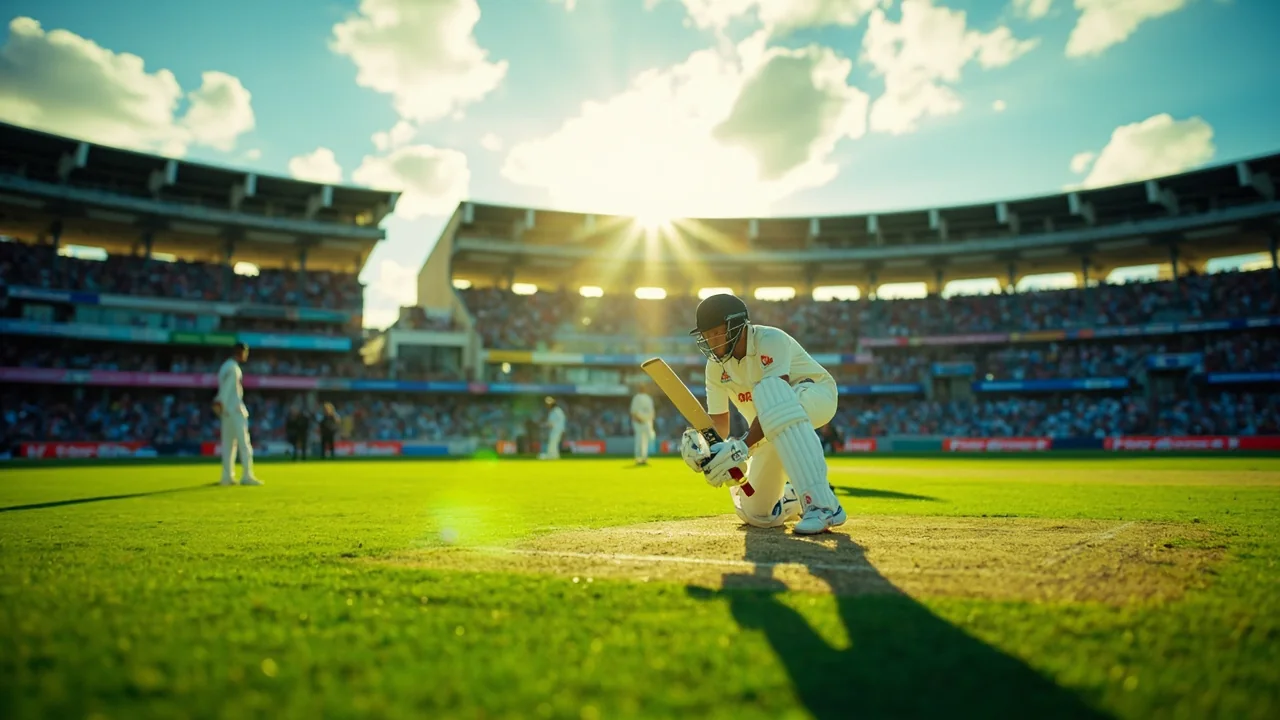
The Board of Control for Cricket in India issued the formal request for proposals on Tuesday, opening a fixed bidding window during which interested companies can submit their commercial offers for the right to be associated with India’s bilateral international cricket at home. The successful bidder will replace the outgoing partner whose tenure concluded with the most recent India home season, and the new name will appear on the LED rings, on-air graphics, broadcast lower-thirds, official media backdrops and the centre-piece branding around every home Test, ODI and T20I India plays until the next renewal cycle.
The BCCI has not publicly disclosed the reserve price for the upcoming cycle, but the tender document circulated to bidders lays out the eligibility criteria, the contract length, the categories of matches covered, and the financial guarantees required to enter the process. Bids are typically submitted in sealed envelopes to the BCCI office at the Cricket Centre in Mumbai, with the evaluation committee opening them on the scheduled date and the highest compliant bid securing the rights.
The new title sponsor will become the second most visible brand in Indian cricket after the IPL’s own title partner, and the timing matters. India’s home schedule for the coming cycle includes a heavyweight Test series, Asia Cup commitments shared with other Full Members, and a clutch of white-ball bilateral series that fill the broadcast calendar between IPL windows. Each of those windows is a guaranteed reach event for any consumer brand, and the BCCI’s commercial partners value them precisely because they consistently deliver the kind of cross-demographic television inventory that has become harder to find on linear television.
What the home events title sponsorship covers
The home events title sponsorship is a category of rights that runs in parallel with, but distinct from, the IPL’s own title sponsor. Where the IPL title sponsor gets every match of the Indian Premier League across roughly two months of the calendar, the home events partner gets every India match played on Indian soil outside the IPL window — that is, the international season. The package covers men’s Tests, ODIs and T20Is, the women’s senior international schedule where BCCI controls hosting rights, and any multi-team tournaments such as the Asia Cup when India is the host association.
Brand visibility is contracted through three layers. The on-ground layer is the perimeter LED rings, the dugout backdrop boards, the press conference backdrops, the stumps branding where applicable, and the giant screens inside the venue. The broadcast layer covers on-air lower-thirds, the scorebug, the innings break bumper, and the title card that appears when the broadcast cuts to the toss and to the post-match presentation. The digital layer covers the official BCCI social channels, the match centre pages, and any co-branded streaming assets the BCCI elects to push through its broadcast partners.
Critically, the home events title sponsor does not have the right to associate with the IPL itself or with any domestic Twenty20 league. Those rights are bundled separately and currently sit with a different partner under the umbrella commercial framework the BCCI renewed a few cycles ago. That separation matters because it gives a bidder a clean brand lane inside Indian cricket without forcing it to bid against the larger, deeper-pocketed categories that dominate IPL side.
Why the BCCI changed the process this cycle
Indian cricket’s commercial rights architecture has shifted noticeably over the last few renewal cycles, and the home events tender is the next data point in that sequence. Earlier cycles saw the BCCI split the package differently, with separate on-ground and broadcast inventory occasionally divided between two or three sponsors. The current structure consolidates most of the visible inventory under a single title partner, which simplifies the negotiation for the board and gives the winning bidder a more complete brand experience across the season.
Two specific pressures have shaped the new process. The first is reach fragmentation. Linear television audiences in India have softened in the metros, but the Indian cricket fan outside the top ten cities still watches bilateral cricket on television in disproportionate numbers, and the title sponsor pays precisely to reach that cohort. The second pressure is regulatory clarity. The BCCI’s commercial partners routinely ask the board to spell out the broadcast inventory, the governance structure for any in-stadia activation, and the contractual treatment of force majeure scenarios such as the pandemic-era curtailment. The tender document is the place where those questions are formally answered before any money changes hands.
There is also a market-tempering effect from the broader corporate cycle. India’s consumer brands have rebalanced their media budgets over the past eighteen months, with several large advertisers trimming sponsorship lines as they redirected spend into digital performance and quick-commerce activations. The home events title sponsorship still sits near the top of any mass-reach media plan, but the ceiling of the bidding has clearly moderated from the COVID-era peak when bidders stretched far past their internal valuations to win the IPL title rights.
Who is expected to bid — and who has stepped back
Three categories of bidder typically contest the home events title rights. The first category is the consumer-facing multinationals — consumer electronics, fintech, automotive, and large FMCG houses — for whom Indian cricket is a once-in-a-generation reach vehicle. The second category is the Indian conglomerate that wants to anchor a multi-year media plan around a flagship sport and is willing to underwrite a long contract to do so. The third is the newer digital-first brands looking to graduate from cricket-themed micro-sponsorships into a top-level association.
Several names from previous cycles are unlikely to re-enter the pool this time around. The most prominent is the auto-and-mobility brand that held the previous cycle and which has publicly signalled a strategic pullback from large sponsorship commitments as it reorganises its marketing spend around electric-vehicle launches. A second name, a fintech that took on a softer association during the last cycle, is widely understood to be conserving capital for product marketing rather than headline sponsorships.
The names most commonly circulated within cricket commercial circles this cycle are a small set of large Indian conglomerates with diversified consumer portfolios, a payments-and-banking brand that has been building cricket exposure through athlete endorsements, and at least one consumer-electronics major that came close on the previous cycle and may return with a higher number. None of those companies have publicly confirmed their participation, and the BCCI itself does not pre-announce the names of confirmed bidders while the window remains open.
How the financial scale compares to past cycles
Indian cricket’s commercial rights have grown at a compound rate that few other sports properties anywhere in the world have matched over the past two decades. The IPL media rights sold in 2023 for roughly a five-year window at a level that reset the entire Indian sport sponsorship benchmark. The home events title sponsorship, while materially smaller than the IPL title, has compounded at its own steady rate and now sits in a band that reflects the inventory value described above.
For the purpose of comparison, the home events title sponsorship in the previous cycle was contracted for a per-year figure that funded a meaningful chunk of the BCCI’s annual non-IPL operations, including domestic cricket compensation, junior pathway funding, the women’s cricket payroll, and a substantial line item for the National Cricket Academy. The contract also carried an annual escalation clause tied either to a fixed step-up or to the consumer price index, depending on the cycle. The same broad financial shape is expected from the new contract.
The reserve price — the minimum the BCCI will accept — is where the cycle’s true signal will land. A high reserve signals the board’s confidence in the bidding depth; a softer reserve signals the board’s willingness to take a guaranteed number rather than gamble on a stretched auction outcome. Historically, the BCCI has erred on the side of accepting a meaningful guaranteed payment while leaving room for the bidder to grow its spend through renewals, and the current market temperament is consistent with that posture.
What changes on the broadcast the moment a new partner signs
The first visible change happens on the graphic frame. Within hours of a new title sponsor being announced, the official broadcast partner is required under its carriage contract to swap the lower-third sponsor credit, the toss graphic, the innings break bumper, and the post-match title screen. Those are mechanical changes that the broadcast operations team executes from the master control room and that the production crew confirms during the next commercial rehearsal.
The on-ground change takes a little longer because it is paid for by separate inventory contracts with the host venues. The new sponsor’s brand-mark lands on the LED rings, the boundary rope markers where contracted, the giant screen takeovers, and the official signage inside the BCCI’s photo zones. By the second home match after the signing, the on-ground look is normally consistent across the venue network.
The digital change happens in parallel with the broadcast swap. The BCCI’s official match centre pages, the player interview thumbnails, the official press release headers, and the social channel headers all carry the new partner’s brand-mark. Cricket fans who watch on the official JioCinema or Hotstar stream see the change overnight; fans who follow the official social channels see it within a day.
Where fantasy cricket fits inside the calendar
For the millions of fantasy players who build teams around every India match, the home events title sponsorship is a familiar but operationally distant piece of the puzzle. The sponsor’s brand-mark appears around the toss, around the boundary rope, and on the broadcast graphics, but it does not change the points system, the squad size, the captain multiplier, or the salary cap. Fantasy contests on platforms like Come Sports India continue to run on the same fantasy rules regardless of which company is on the LED ring.
Where the change does register is in the broadcast moments that fantasy players track closely. The on-air toss graphic, the powerplay summary bumpers, and the between-innings analyst segments all carry the new partner’s branding, and the broadcast production teams sometimes refresh the editorial blocks around the same window. That timing is sometimes a useful signal for fantasy players who watch the pre-match show with a notepad: new sponsor usually means new title card, new bumper music, and a refreshed graphics package that is easier or harder to track in real time.
The deeper knock-on effect is in the women’s international calendar. The BCCI’s expansion of the women’s home schedule over the last few cycles has run alongside the corporate market’s growing willingness to underwrite that inventory separately. A strong home events title deal gives the board additional headroom to fund more women’s bilateral cricket, more women’s T20Is at marquee venues, and larger central contracts for the women’s squad, all of which feed the same fantasy ecosystem as the men’s matches.
What to watch over the next two weeks
Three signals will tell the real story of the home events title sponsorship cycle. The first is the number of sealed bids the BCCI receives. A field of three or more sealed bids points to genuine demand; a field of one or two suggests the market has thinned and that the reserve price will hold. The second signal is the gap between the winning bid and the reserve. A thin gap implies the market cleared roughly where the BCCI expected; a wide gap implies there is still aggressive money in the pool.
The third signal is the identity of the winning bidder’s industry. A consumer-facing brand from outside cricket’s traditional sponsor pool — a mobility company, an edtech firm, a quick-commerce player — would be the strongest single indicator that India’s sport sponsorship market has widened beyond the historical conglomerate-and-banking axis. A repeat bidder from the previous cycles would confirm the market is stable but not expanding.
The BCCI is expected to publish the outcome shortly after the bids are opened. Until then, the formal process keeps running quietly: sealed envelopes, eligibility verifications, financial guarantees, and the slow accumulation of bid documents that will, by the end of the window, determine which brand-mark India’s home cricket fans will see every time a bowler runs in.