13
Jul
Dream11 Crorepati Winners 2026: How India's Top Fantasy Cricket Players Won Big
Inside the Dream11 crorepati winners of 2026 — the contest structures and payout methods.
WinnersRead →
A practical fantasy cricket points calculator that turns IPL 2026 player projections into a defensible team selection — with the formulas captains actually use to clear mega-contests on Dream11, My11Circle and Come Sports India.

India’s fantasy cricket contestant pool exploded past 30 million active users in IPL 2026, and the gap between casual teams and leaderboard-topping lineups is no longer luck — it’s arithmetic. A fantasy cricket points calculator that you can re-use across every match-day lets you project each player’s expected output, weight it against credit cost, and lock your team 15 minutes before toss with a defensible score.
The calculator isn’t a fancy tool. It’s a single spreadsheet with seven input columns and one output column: points-per-credit. Run that across your shortlist of 25-30 players before every match, and the captain and vice-captain picks write themselves. Everything below is the formula, the inputs, and the IPL 2026 worked example.

Batting points in IPL 2026 follow the standard Dream11 / Come Sports India baseline. Every run scores one point, a boundary adds a four-point bonus on top, a six adds six. A duck — batsman dismissed for zero — costs two points, which is the single biggest leverage point differential captaincy picks get wrong.
Milestones stack: thirty runs is worth an extra four points, fifty is worth an extra eight on top of the base, a seventy-five is worth four more, and a century adds sixteen. So a 102-run knock scores 102 runs + 102 boundaries/sixes bonuses + 16 century bonus = a base figure north of 130 before captaincy. Use the run component as 1.0× in the calculator and add the boundary / six / milestone components as multipliers rather than flat values to keep the math consistent across match formats.
Bowling is where contests get won. Every wicket is worth 25 base points, plus four bonus points per wicket for an LBW or bowled dismissal, which is why strike bowlers score disproportionately well on points-per-credit. Maiden overs add four points each — a quiet but compounding line. The 3-wicket, 4-wicket and 5-wicket hauls unlock bonuses of 4, 8 and 16 points respectively.
The leverage: a 4-wicket haul at an economy under 7 is worth 100+ bowling points. Plumb that onto a player priced at 9 credits and the points-per-credit clears 11 — the threshold every serious team should target before considering a captaincy tag.
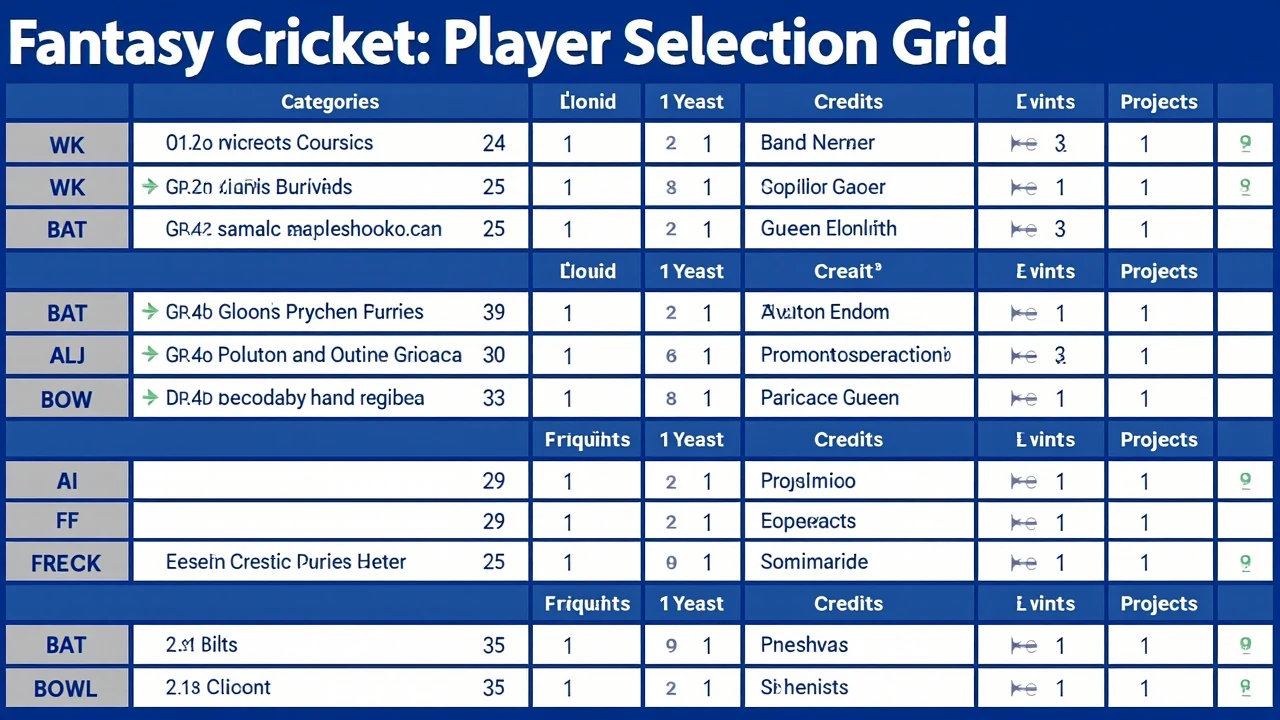
Catches are 8 points each, stumpings 12, run-outs split between the thrower (12) and the catcher (6 or 8 depending on length of throw). The 2026 rule change worth noting: any catch taken at a position inside the 30-yard circle adds a 4-point inner-ring bonus in some contests — check the rules card for your specific contest.
Wicketkeeper-batters benefit the most because they accumulate stumping points on top of catches and batting points. A WK with 25 runs, 2 catches and 1 stumping projects at 25 + 16 + 12 = 53 base points — very high leverage on the vice-captain slot.
The captain scores 2.0× the base fantasy points. The vice-captain scores 1.5×. This is the most important number in the entire system. A 70-run captain knock becomes 140 base-equivalent points; the same innings as vice-captain is 105; the same innings as a non-multiplier pick is just 70. In mega-contests with 100,000+ teams, the captain multiplier is the single biggest source of leaderboard variance.
The corollary: never give the captain tag to a player outside the top 5 of your projected points-per-credit list. Differential captaincy on second-tier all-rounders “because the matchup looks good” is the most common losing play in the fantasy community.

Take the projected points for an opening contest: batter A 75 runs (no captain multiplier) = 75 + boundary bonus 8 + milestone 8 = ~91; bowler B 3 wickets = 75 + 12 LBW bonuses + 4 three-fer bonus = 91; all-rounder C 35 runs + 2 wickets = 35 + 8 (boundaries) + 50 (2 wickets) = 93; wicketkeeper D 25 runs + 2 catches + 1 stumping = 53.
Now apply captain to the highest projected base — say all-rounder C at 93, becoming 186. Vice-captain to bowler B at 91, becoming 136.5. Total team base points (assuming the other seven players average around 45 each) = 186 + 136.5 + 91 + 75 + 53 + (7 × 45) = 856.5. That is a top-1% leaderboard projection at 100 credits. Multiply the captain pick by 2.0× and the rest follows from base arithmetic.
First, never project more than 100 runs for a single player — the ceiling math breaks the captain-multiplier leverage. Second, never project more than 4 wickets for a single bowler in T20 — 5-fers are 1-in-50 events and they distort the team total if you assume them routinely. Third, weight wicketkeeper-batters 1.3× relative to a pure batter of the same run projection because of the fielding bonus — but only if the WK is genuinely the best gloveman in the side, not a part-time stumper.
The fantasy cricket points calculator is therefore not a single number — it’s a process. Project. Filter. Captain. Lock. Repeat across 70 IPL 2026 matches and the math compounds into a leaderboard finish that gut-feel teams never reach.
Every formula assumes the player’s role stays as projected. An all-rounder picked for his bowling who bats at number three instead of number eight will outscore his projection. A death-over specialist who doesn’t bowl his full quota because the captain rested him in a winning position will undershoot. The calculator should be re-run 30 minutes before toss with the confirmed playing XI and any announced batting-order changes — the projection window is short.
Use the formula as a starting point, not a guarantee. The 1-in-50 events — a bowler’s 5-wicket haul, a No. 8 batter’s fifty, a run-out hat-trick in the field — are not projectable. They are variance to be embraced, not predicted.
The IPL 2026 mega-contest calendar runs across 70 league matches plus four playoff fixtures. The teams that win big prizes are the ones that build a calculator-driven process and run it consistently — same projection template, same captain filter, same captain-multiplier discipline. The teams that chase last week’s leaderboard differential are the ones whose process drifts and whose monthly spend compounds into nothing.
Set up the points-per-credit calculator today, run it on three sample contests, and lock your first IPL 2026 team with arithmetic on your side. The leaderboard will not look back.
No points calculator changes the underlying probability of clearing a seven-figure payout on a Rs 49 entry. That probability remains in the one-in-several-million range across the largest contests. Come Sports India’s editorial recommendation stands: fantasy cricket is a skill activity that rewards disciplined process, not a path to regular income. Set a monthly cap, never chase losses, and treat contests above Rs 500 as entertainment spend rather than investment.
Use code INDIA100 for Rs 100 welcome bonus.
Inside the Dream11 crorepati winners of 2026 — the contest structures and payout methods.
When to deploy the rare triple-captain chip in long-format fantasy contests.